
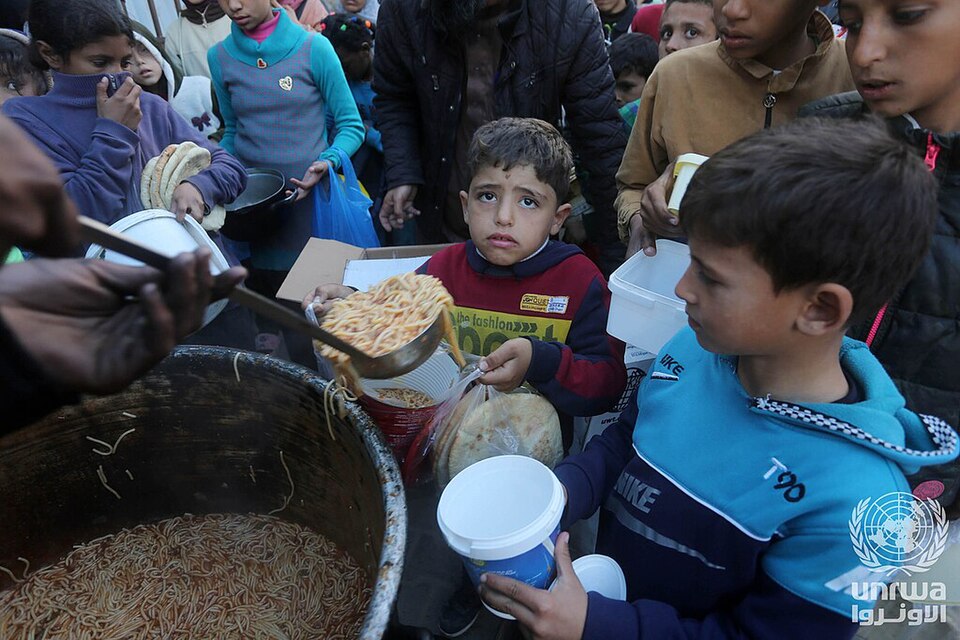
Displaced Palestinians receiving food in Deir al-Balah, Gaza
Palestine · GazaChildren · Food & Nutrition

Palestinian Children Essential Food and Nutrition Support Plan

01

Project name

Palestinian Children Essential Food and Nutrition Support Plan

Children · Food & Nutrition · Palestine · Gaza
02

Project background

This plan responds to a severe and volatile child food-security and nutrition situation in the Gaza Strip. The latest publicly available IPC joint analysis estimated that about 1.6 million people faced high acute food insecurity and projected that nearly 101,000 children aged 6–59 months would experience acute malnutrition and require treatment through mid-October 2026, including more than 31,000 severe cases. It also found poor dietary diversity, limited access to protein-rich foods, high prices, unsafe food preparation and storage conditions, and major gaps in health, nutrition, water and sanitation services. These conditions mean that a generic food parcel alone is not an adequate child-focused response.

WFP reports that food parcels, bread, hot meals and cash-based assistance are all in use, but affordability, market disruption, access restrictions, unemployment and supply instability remain material constraints. UNICEF's 2026 child-focused assessment documents severe, overlapping risks across health, nutrition, WASH, disability inclusion and child protection after repeated displacement and the breakdown of essential services. Conditions differ by location and can change quickly as access routes, market supplies, fuel, water and population movements shift. Any intervention must therefore be based on a current local assessment and coordinated against existing assistance so that scarce resources reach eligible children without duplication or exclusion.

03

Project objectives

  • Improve reliable access to safe, age-appropriate and nutritionally adequate food for eligible children in the approved pilot area.
  • Identify children at risk of acute malnutrition and support timely access to qualified nutrition or health services.
  • Improve dietary diversity, meal frequency and access to nutrient-dense foods for participating children where local conditions permit.
  • Reduce child health risks linked to food shortages, unsafe water, inappropriate feeding and unsafe food preparation or storage.
  • Provide fair, safe and accessible service pathways for children with disabilities, children without stable caregivers and repeatedly displaced families.
04

Target population

  • Children aged 6–59 months at risk of acute malnutrition, with screening and referral managed by qualified nutrition personnel.
  • Children in food-insecure households, including orphaned or separated children, female-headed households and families experiencing repeated displacement.
  • Children with disabilities or special dietary and access needs, subject to safe and non-discriminatory eligibility procedures.
  • Pregnant and breastfeeding women in eligible child households where maternal nutrition affects child health.
  • Caregivers who require safe infant and young-child feeding information, referral guidance and an accessible complaints channel.
05

Service content

  • Regular access to age-appropriate food through food parcels, bread, prepared meals, restricted food vouchers or controlled cash support according to verified household conditions.
  • Nutrition-risk screening for participating children, with safe referral to qualified nutrition or health services when moderate or severe risk is identified.
  • Caregiver guidance on age-appropriate feeding, safe food preparation, water use, storage and recognition of nutrition danger signs.
  • Accessible service arrangements for children with disabilities, children without stable caregivers and repeatedly displaced families.
  • A confidential complaints, feedback and referral channel that children and caregivers can use without losing eligibility.
06

Delivery model

  1. 01

    A qualified local service partner enrols eligible households through safe, non-discriminatory criteria and anonymous household identifiers.

  2. 02

    Food is delivered through the locally suitable combination of scheduled food parcels, bread, prepared meals, restricted vouchers or controlled cash support.

  3. 03

    Families receive services at accessible community distribution points, partner facilities or another safer approved option when travel is unsuitable.

  4. 04

    Nutrition screening and caregiver guidance are provided alongside delivery or through scheduled partner appointments, with direct referral for children requiring treatment.

  5. 05

    Delivery frequency and the food modality are adjusted to verified household cooking, water, storage, mobility and special-diet conditions.

07

Protection requirements

  • Apply child safeguarding, prevention of sexual exploitation and abuse, informed consent and a staff code of conduct.
  • Never make a child's image, name, address, story or precise location a condition of receiving service; publish only de-identified aggregate information.
  • Use fair eligibility rules and safe access arrangements for girls, boys, children with disabilities and unaccompanied or separated children.
  • Provide confidential, locally accessible complaint and referral channels with defined response and escalation times.
  • Avoid infant-formula distribution unless a qualified health or nutrition protocol confirms need, safe water, preparation support and follow-up.
08

Supply-chain controls

  • Screen the partner, beneficial owners, bank, suppliers, transporters, warehouses, subcontractors and final payment beneficiaries before contracting and payment.
  • Use approved supplier lists, competitive quotations where feasible, batch and expiry records, food-quality checks and temperature controls when required.
  • Separate ordering, receipt verification and payment approval; pay against documented milestones rather than uncontrolled advances.
  • Maintain purchase orders, invoices, transport records, stock cards, loss reports, distribution summaries and financial reconciliation by batch.
  • Maintain backup suppliers, routes and delivery modes; reassess prices, access, fuel, water and storage conditions before each cycle.
09

Monitoring indicators

  • Unique children and households enrolled, disaggregated by age, sex, disability and area without publishing identities.
  • Delivery completion rate, delivery frequency, food-basket or meal quantity, timeliness, stock loss and verified receipt rate.
  • Children screened for acute malnutrition; moderate/severe cases identified; referral completion and confirmed service access.
  • Minimum dietary diversity or other partner-approved child diet indicators measured at baseline and review where feasible.
  • Complaints received, resolved within target time, safeguarding incidents, data incidents and corrective actions.
  • Cost per completed household cycle, procurement variance, logistics share, exception rate and reconciliation completeness.
10

Cost framework

  • Food commodities, bread, prepared meals, restricted vouchers or controlled cash value, depending on the approved modality.
  • Nutrition screening, counselling, referral coordination and qualified clinical or nutrition partner services.
  • Local procurement, packaging, warehousing, transport, distribution sites, fuel and necessary quality controls.
  • Child safeguarding, accessibility, complaints handling, translation and privacy-protected data management.
  • Partner due diligence, sanctions and payment-path review, monitoring, financial reconciliation, audit and customer reporting.
  • Care2Luck project research, coordination, platform operations and payment processing, plus a documented contingency reserve.
11

Project pause conditions

  • The local partner, bank account, supplier, subcontractor or final beneficiary cannot be verified or creates sanctions or diversion risk.
  • Safe access, lawful transfer, food quality, water, storage, transport or distribution conditions no longer meet the approved threshold.
  • A serious safeguarding, exploitation, privacy or security incident occurs, or the complaint mechanism is not functioning.
  • Inventory, delivery evidence and financial records cannot be reconciled, or a partner refuses monitoring or audit access.
  • The service materially duplicates another programme, excludes eligible groups unfairly or causes foreseeable harm or disorder.
  • Material scope, price or access changes exceed approved tolerances; management must reapprove before restarting.